Biology (life cycles)
Alternation of generations in the life cycle of Rhabdias
bufonis was discovered by Mecznikow (1865) and first published
by Leukart (1865). The comprehensive information on the development
of this species is expanded in the papers of Schaake (1931) and
Spieler and Schierenberg (1995). In this species, eggs of parasitic
hermaphrodites pass from the host lungs into the intestine, accumulate
in colon and, thereafter, are cast out of the host organism in
faeces. The free-living stages develop in the droppings. Larvae
from the eggs of hermaphrodites reach maturity as males and females
of gonochoristic generation. The latter give rise to the hermaphroditic
generation larvae which develop in droppings up to the third stage.
At this stage the larvae become infective and are able to continue
development only after the penetration into the host.
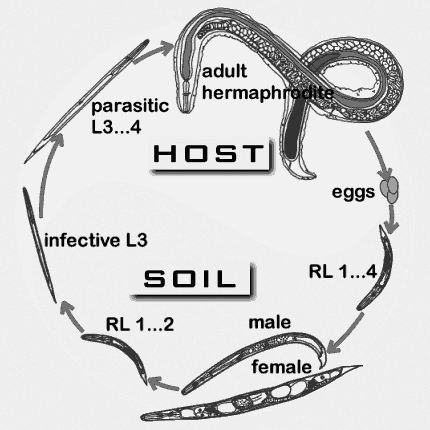
Fig. 1. Rhabdiasoid life cycle: strict
alternation of two generations.
Railliet (1899) and Goodey (1924 a) failed to observe the
gonochoristic generation in R. fuscovenosa. This species
was considered to develop directly, in contrast to other species
of the family. However, Chu (1936 b), after thorough examination
of the development of R. fuscovenosa in laboratory cultures
and, with original cultivation method applied, found out that
the smaller part of hermaphroditic generation progeny developed
indirectly. The progeny of the latter underwent the metamorphosis
during the second moult and the third-stage larvae had filaroid
morphology, in contrast to rhabditoid homogonic infective larvae
and infective larvae in other species. These filariform larvae
failed to infect the hosts. The author believed that both homogony
and heterogony were characteristic for the life cycles of all
Rhabdiasidae (as they were in Strongyloididae) but the former
way predominated in amphibian parasites and the latter one predominated
in the species from reptiles. The hypothesis of Chu, however,
has not been confirmed by the other authors, who investigated
the development of various rhabdiasid species, even when Chu's
method of cultivation has been applied (see, for example, the
works of Baker (1978) and Kuzmin (1997, 2000). Homogony was not
found in the life cycles of amphibian parasites, nor it was in
the life cycles of species from chameleons and lizards (i. e.
R. gemellipara, R. chameleonis, Pneumonema tiliquae,
Entomelas spp.). The only two species that have been found
to possess the life cycles similar to that in R. fuscovenosa
and Strongyloides spp. were R. elaphe and R.
agkistrodonis (Kuzmin 1999; Kuzmin and Miskov 1999). Both
species are the parasites of snakes. Heterogonic infective larvae
in these species are rhabditoid and morphologically similar to
the homogonic ones.
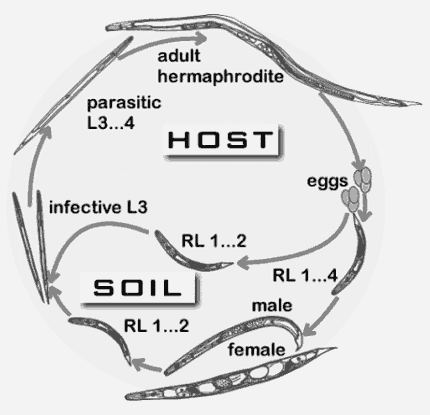
Fig. 2. Strongyloid life cycle, combination
of heterogony and homogony.
|


